
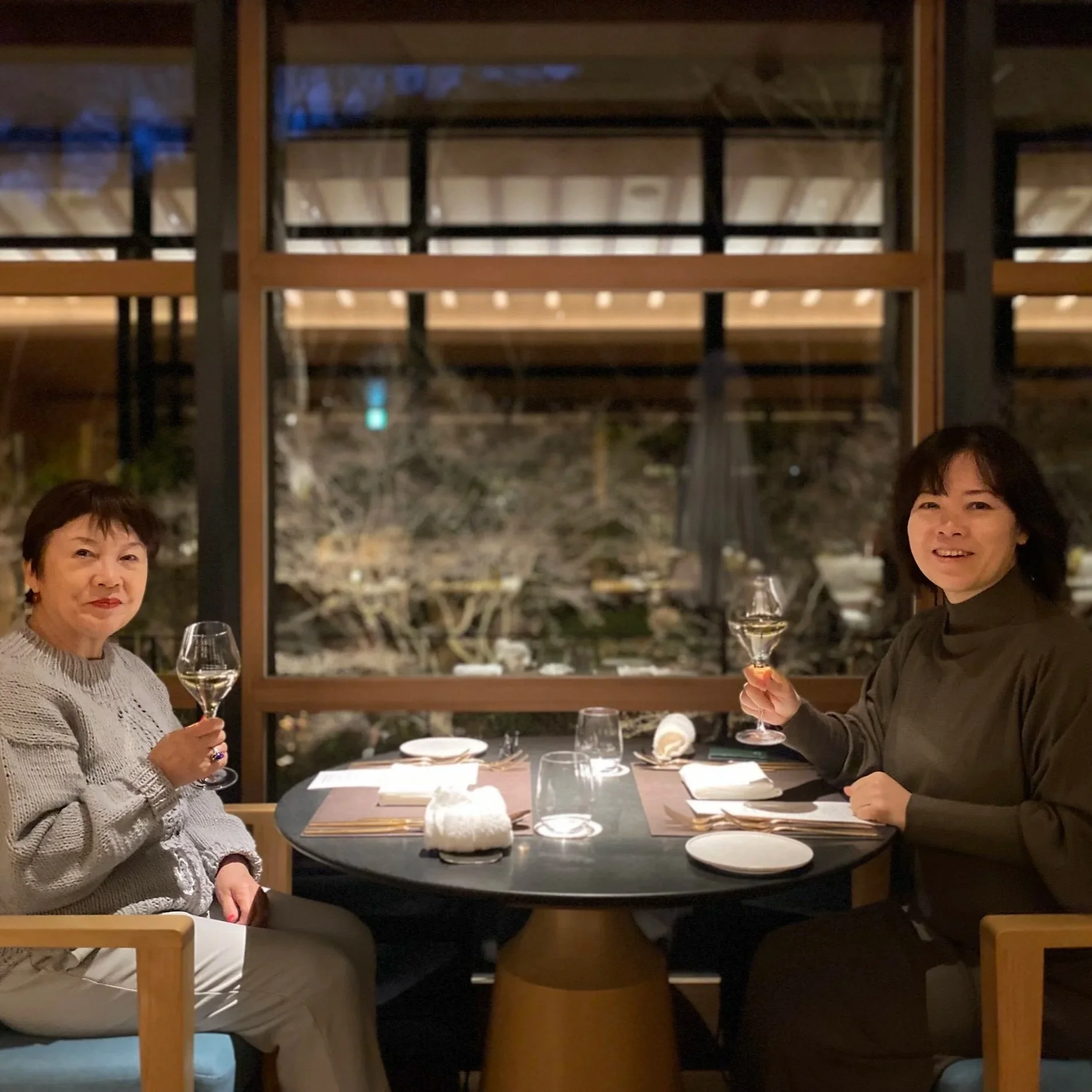
Apart from some restaurants and high-end hotels in big cities like Tokyo and Osaka, and in resort towns, most Japanese people dress quite conservatively. I haven't met your grandparents, but it's probably safe to say that dressing to please them, or out of respect for the older generation, is the best policy in Japan.
Dress up a little more for formal restaurants, such as kaiseki and other multi-course dinners. For most restaurants, dressing up isn't necessary. Just don't dress too casually.
Jeans and Tatami
Jeans are perfectly fine. My only concern is sitting on tatami. If you're wearing tight jeans, you'll regret it. And it's not only tatami rooms. There are other occasions when we have no choice but to sit on tatami or wooden floors. On my Gifu tour, the boat ride is exactly one of those times.
Don't worry if sitting on the floor is hard for you. Most Japanese people now prefer sitting on chairs too. If you're making a reservation at a Japanese restaurant that has both tatami rooms and tables, it's better to ask for table seating. You can say "Tēburu-seki wo onegai shimasu" (テーブル席をお願いします), which means "Table seating, please."
Even some kaiseki restaurants have started placing zaisu, Japanese-style low chairs, on the tatami. These same restaurants used to charge an extra fee when I asked for them while booking for my tour guests. Now they seem to offer them as standard, and they no longer charge me. Things have changed a lot in the last 15 to 20 years.
Clean Socks Are a Must in Japan
Whenever you enter a house, you'll be taking your shoes off. This happens more often than you might expect, at homes, ryokan, temples, and some restaurants. Shoes that slip on and off easily will save you a lot of fuss, especially when everyone is waiting at the entrance. And please check your socks before you leave in the morning. Holes in your socks are much more noticeable when you're sitting on the floor. Sometimes you'll be given slippers to wear inside, but take them off before stepping onto the tatami. Tatami is for socks or bare feet only.
I see so many non-Japanese tourists take off their shoes and then walk around the entrance in their socks or bare feet before stepping inside. For Japanese people, this is almost taboo, a kind of cross-contamination. When you take off your shoes, step straight up onto the indoor floor, never onto the floor where you left your shoes. It's such an important rule, but I know it can be hard to see from the Japanese point of view. When you travel with me, this is the first thing I demonstrate, so you'll get it right from the start.
Dressing for the Season
T-shirts, shorts, and flip-flops are fine in summer at casual restaurants by the beach or the river, or around your own neighborhood. Otherwise, shorts and flip-flops are considered summer clothes and are often seen as too sloppy. If you wear them in fall, people will look at you and wonder why you're still dressed for summer. That was true when I was growing up, and it's still somewhat true today.
In LA, when we saw someone in a T-shirt in winter, we'd think they must be from Chicago, or even Alaska. But in Japan, among Japanese people, seeing someone dressed for a different season simply puzzles others.
You might wonder why everyone dresses so similarly. Japan is a long chain of islands stretching from south to north. It has four distinct seasons, though their length varies depending on where you are. Summer comes early and stays long in Okinawa, while fall arrives much sooner in Hokkaido. Even so, people in each place change their clothes together, following the season where they live. Schools have two uniforms, one for summer and one for winter. Spring and fall are transitional times, when students adjust by wearing short sleeves, or long sleeves with a vest or cardigan. Just by looking at what students are wearing, it's hard to miss the change of season in Japan.
We also have a word, koromogae (衣替え), which means changing the wardrobe in your closet. At the beginning of fall, we put away spring and summer clothes and fill the emptied closet with fall and winter clothes. This custom probably also comes from the limited space in Japanese homes. In recent years, summer has lingered well into fall, and such a complete change of closet can feel a bit drastic and outdated. Still, most Japanese people are conscious of this custom and practice it more or less.
My family often laughs at how I dress and has to point out that my clothes aren't quite right for the season. I lived in warm LA for so long that I'm no longer very attuned to dressing in step with the Japanese seasons.
These days, you can easily check the weather where you're going. Look at the lowest and highest temperatures, and bring some layers so you can adjust. While you're traveling, your body is already working hard to get used to a new time zone and different weather. You can't be too kind to your own body.
A Note on Perfume
In general, Japanese people are not used to strong perfume. Historically, the nobility burned incense and draped their kimono over it so the fragrance would sink into the fabric. To this day, subtle scents are preferred in Japanese culture. Naturally, many Japanese restaurants ask guests not to wear strong perfume, so that you can enjoy the natural aroma of the dishes you're about to taste, and out of consideration for the other guests. That said, of all the people I've met on my tours, I've never had to ask anyone to tone down their perfume.
In the end, what matters most is a conscious wish to be respectful toward the country you're visiting. Japanese people always appreciate those who show respect. It's not only about how you dress, but your attitude as well. I'm quite sure that anyone reading this will have no trouble at all while traveling in Japan.